Electric Transport
Liftroller E Wagon electric material handling trolley
The Liftroller E Wagon is a remote-controlled electric material handling trolley with a roller top, rated to 1,200 kg. It parks against the Liftroller Wall so a pack rolls straight off the platform onto the wagon, then one person drives the load to where it is needed using a one-handed remote.
 1 / 7
1 / 7Talk to the team
Get pricing on the Liftroller E Wagon
Tell us the floor levels, the openings you have and what you need to move. We'll come back with the right setup and what it costs.
A real reply, usually same day
Weekdays, from the team in Sydney. Not an autoresponder.
We'll tell you if it's the wrong fit
If another machine in the range suits your access better, we'll say so.
Under a minute to fill
Name, email and a number so we can call you back. Everything else is optional.
What the Liftroller E Wagon does
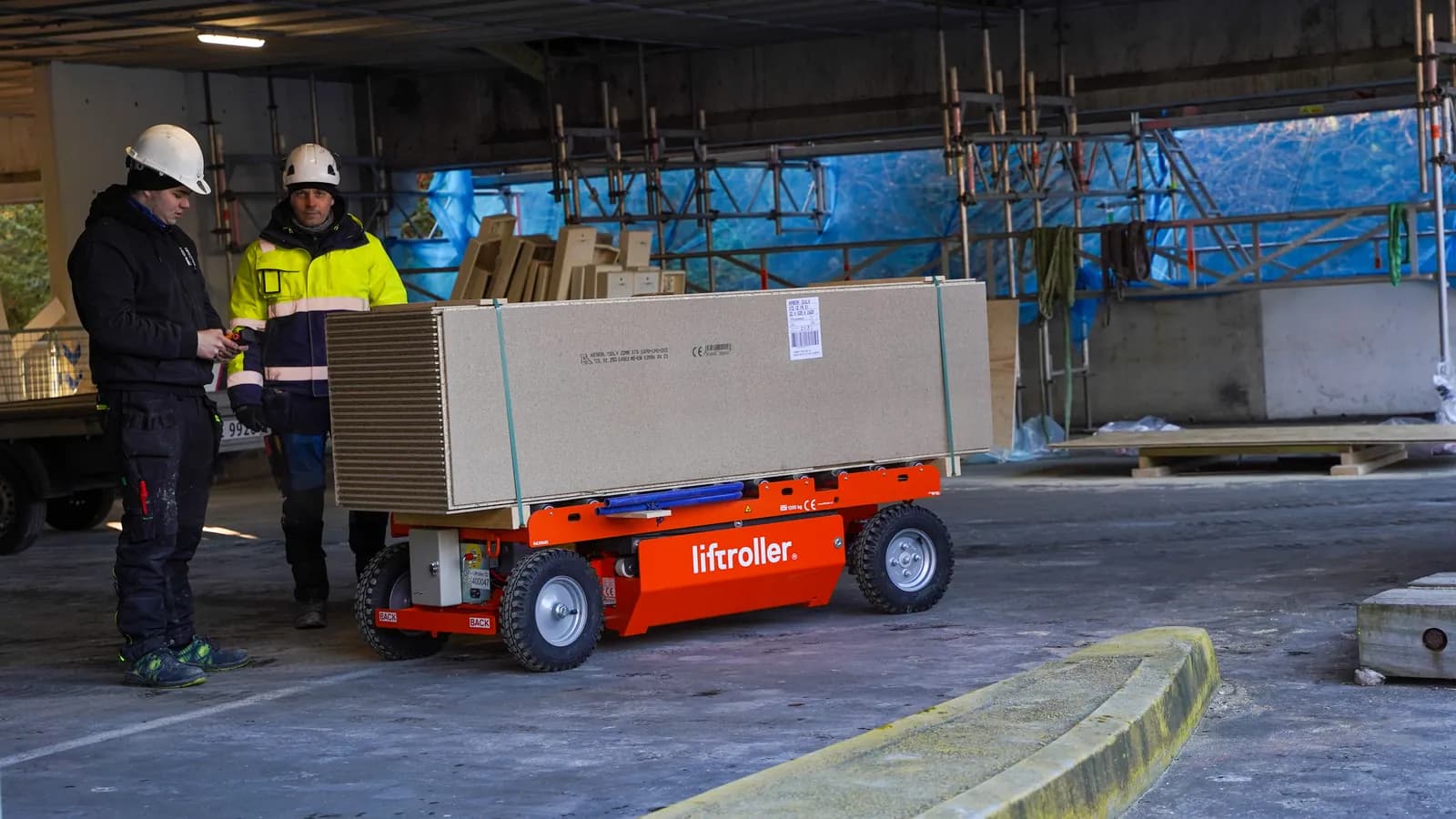
The E Wagon is the machine that takes the load off the landing platform and puts it where the trade is working. The top is a roller bed set to the same height as the Liftroller Wall, so a pack transfers across without being lifted.
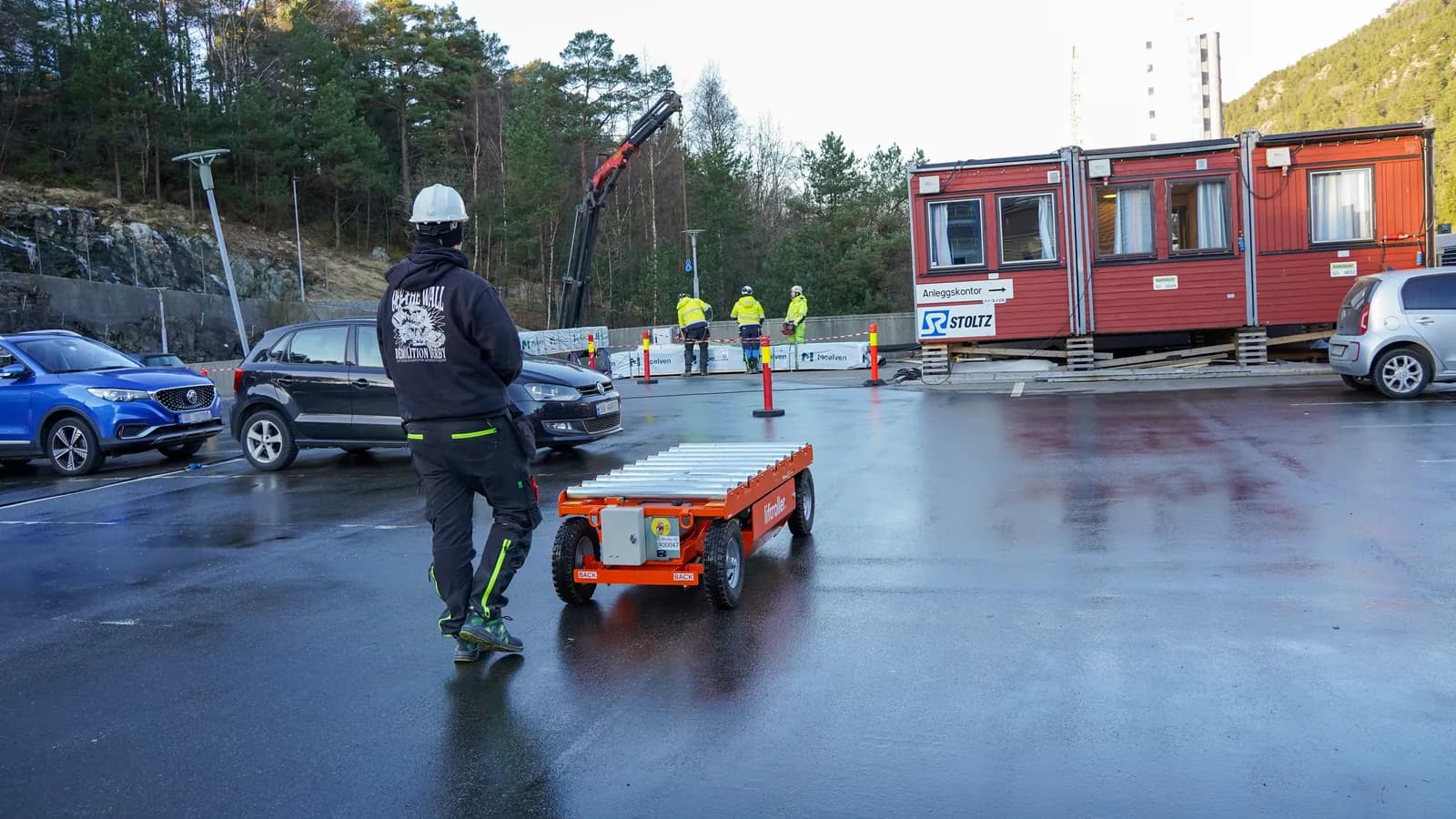
It is driven by remote rather than a tiller handle. That sounds like a small thing and it is not: with no handle in the way you can turn a full pack in a corridor, and the operator can walk beside the load and watch the clearances instead of walking backwards in front of it.
It carries 1,200 kg and weighs 570 kg empty. The travel speed is limited until the roller bed is lowered, so it will not run at full speed with the deck up.
How it works on site
- 1
Park it against the platform
The roller top lines up with the deck of the Liftroller Wall, so the two form one continuous run.
- 2
Roll the pack across
No lifting. The load moves from the platform onto the wagon on rollers.
- 3
Drive it out on the remote
One-handed control, steering on both axles, no handle to foul the load in tight corridors.
- 4
Set it down at working height
Lower the pack onto trestles so the trade can work off it directly, and the wagon goes back for the next delivery.
What it moves once it is inside
The E Wagon is the link between the loading point and the work face. It takes whatever came off the platform and drives it out to the trade.
- Full packs of plasterboard
- Palletised tile and stone
- Ductwork and pipe runs
- Framing and timber
- Joinery and fitout components
- Offcuts and waste, on the way back
Before we used Liftroller, there was a lot of carrying. The materials were placed in the backyard and carried in from there. With Liftroller, everything was much easier, and the workers did not have to wear themselves out. Absolutely brilliant!
Technical specifications
Every figure below was verified against the manufacturer's Australian specification sheets in August 2026.
| Specification | Value |
|---|---|
| Minimum height trolley | 535 mm |
| Maximum height trolley | 1235 mm |
| Length roller table | 1700 mm |
| Width roller table | 786 mm |
| Length trolley | 2110 mm |
| Width trolley | 810 mm |
| Charging power | 230 V |
| Battery | 2 x 12 V |
| Engine | 24 V |
| Tare weight total | 570 kg |
| Max. weight load (WLL) | 1200 kg |
| Speed | 0 to 6 km/h |
Key features
- Carries up to 1,200kg
- One-handed remote control operation
- Powered raise and lower, 535 to 1,235mm
- Automatic roller braking to secure the load
- No handle to obstruct the load when turning
- 230V charging (110V on request)
See it working
Got a question about your site?
Openings, floor levels, load weights: send us the details and we'll tell you straight whether the Liftroller E Wagon is the right call.
Where it is used
Plasterboard distribution
Move full packs from the loading point out to each room on the floor without a single sheet being carried.
Long corridors
Remote control and dual-axle steering make it workable where a tiller-handled trolley cannot turn.
Fitout on live floors
Quiet and electric, so it suits occupied buildings and out-of-hours work.
Clearing waste
Runs both ways. Take offcuts back to the loading point instead of stacking them in the corridor.
E Wagon or E Mover
Same machine underneath, same 1,200 kg rating, same remote. The top frame is the difference, and it decides which one suits your job.
This page
Liftroller E Wagon

| Attribute | Liftroller E Wagon | Liftroller E Mover |
|---|---|---|
| Top frame | Roller bed | Flat deck |
| Working load limit | 1,200 kg | 1,200 kg |
| Own weight | 570 kg | 540 kg |
| Deck height range | Matches the platform | 535 to 1,235 mm |
| Loads roll on without lifting | Yes | No |
| Doubles as a working bench | No | Yes |
| Remote controlled | Yes | Yes |
| Steers on both axles | Yes | Yes |
| Trestle slots | Yes | Yes |
| Lifting points for crane or forklift | Yes | Yes |
Choose Liftroller E Wagon when
Loads come off a roller line: a Liftroller Wall, a Floor, or a run of tables.
Choose Liftroller E Mover when
Loads are lifted on rather than rolled on, and you want a bench at working height.
Want Liftroller E Wagon pricing for your site?
Leave your details and we'll call you back with availability and what it costs for your job.
Working out whether it pays
The honest answer depends on how far your materials have to travel once they are on the floor. These are the lines to count.
Labour hours on material handling
Count the people and the hours currently spent carrying, and what those hours are worth on your rates. This is usually the biggest line by a distance.
Crane and hoist time
Every lift to ground level that then has to be moved again is a lift you paid for twice. Landing on the floor removes the second handling.
The goods lift
If materials are going up in the lift, other trades are waiting for it. Freeing the lift has a programme cost attached that rarely gets counted.
Rigging and ground space
External hoists and scaffold bays need somewhere to stand and something to tie to. On a tight site that space has a real cost, or does not exist at all.
Damage and rework
Carried materials get dropped, scuffed and cornered. Sheets rolling on a level bed do not.
Injury and lost time
Manual handling is one of the largest causes of lost-time injury in Australian construction. Fewer carried loads is fewer chances for a back injury on your job.
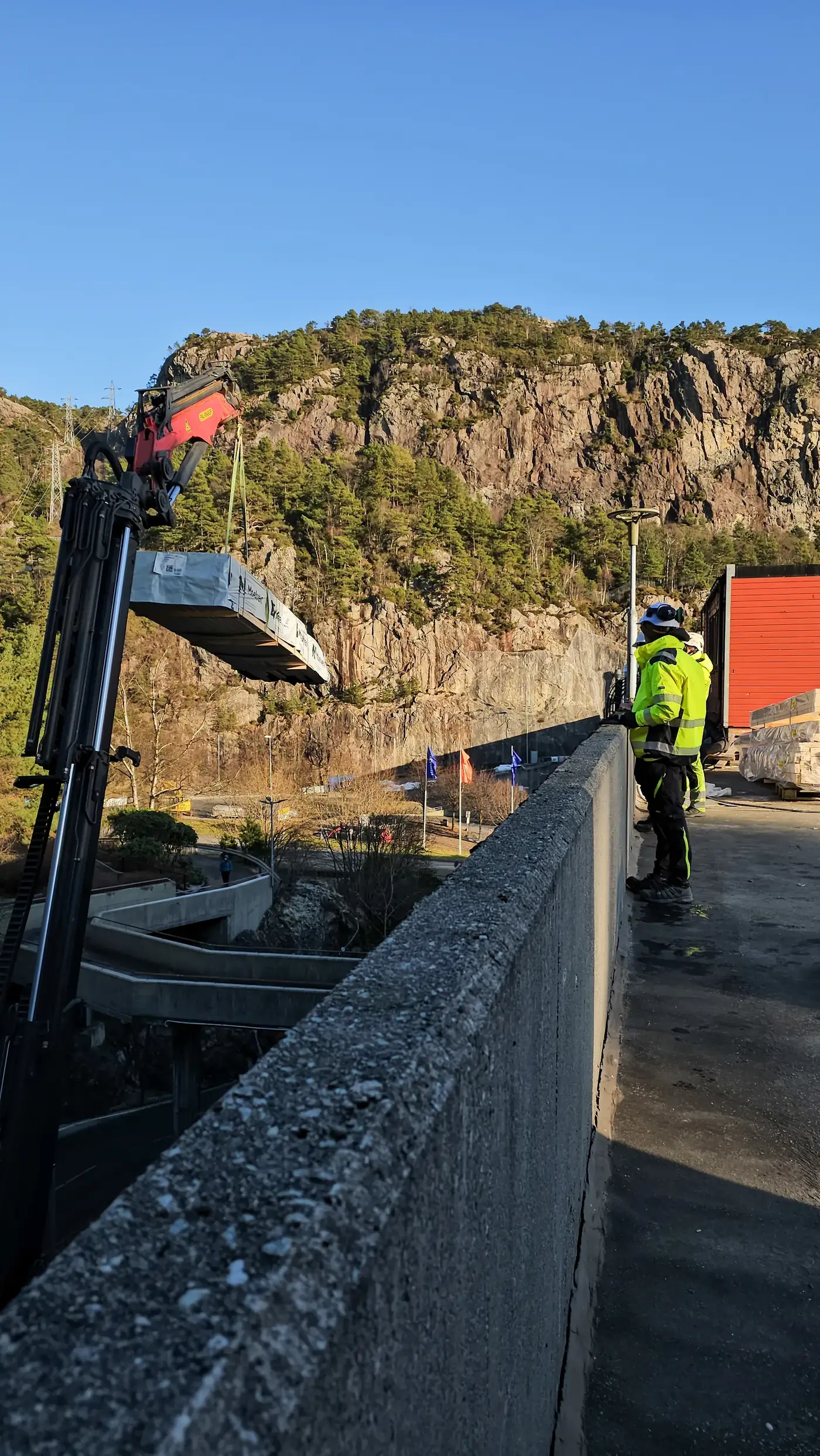
On one Norwegian job, a clinic fitout on the sixth floor of a shopping centre, the site sat above a parking deck and the boom truck could not reach the building at all. Materials were craned to the deck, moved across it on the E Wagon, then lifted into the facade opening and driven to the work face. That is the kind of access problem it solves. Tell us yours.
Common questions
It is a remote-controlled electric material handling trolley with a roller top, rated to 1,200 kg, designed to pair with the Liftroller Wall so packs roll off the platform without being lifted.
1,200 kg. The wagon itself weighs 570 kg.
With no handle there is nothing obstructing the load when you turn, which matters in corridors. The operator can also walk alongside the load rather than backwards in front of it.
The top frame. The E Wagon has a roller bed for transferring loads off a roller line. The E Mover has a flat deck. Everything else is the same.
From a 230 V supply, with the charger built into the wagon.
It has integrated lifting points so a crane or forklift can move it. It is not a lift, so plan how it gets to each level.
Not covered here? Talk to our team and we will answer it against your actual site.
Works with
The Liftroller range is a system. These are the pieces most often used alongside this one.


Hire or buy
Let's work out if the Liftroller E Wagon fits
Send us the loads, the access and your dates. You'll get a person who knows the gear, not a sales script, and a straight answer on whether this is the right machine for the job.
A real reply, usually same day
Weekdays, from the team in Sydney. Not an autoresponder.
We'll tell you if it's the wrong fit
If another machine in the range suits your access better, we'll say so.
Under a minute to fill
Name, email and a number so we can call you back. Everything else is optional.
Liftroller E Wagon
Get pricing and availability