Building Access Systems
Liftroller Wall loading platform
The Liftroller Wall is a mobile loading platform that clamps into an existing window or facade opening and forms a roller conveyor between the outside of the building and the floor inside. It carries up to 1,200 kg, assembles in about 10 to 15 minutes without tools, and lets a crane land materials directly on the floor they are needed on.
 1 / 10
Talk to the team
Get pricing on the Liftroller Wall
Tell us the floor levels, the openings you have and what you need to move. We'll come back with the right setup and what it costs.
A real reply, usually same day
Weekdays, from the team in Sydney. Not an autoresponder.
We'll tell you if it's the wrong fit
If another machine in the range suits your access better, we'll say so.
Under a minute to fill
Name, email and a number so we can call you back. Everything else is optional.
What the Liftroller Wall does
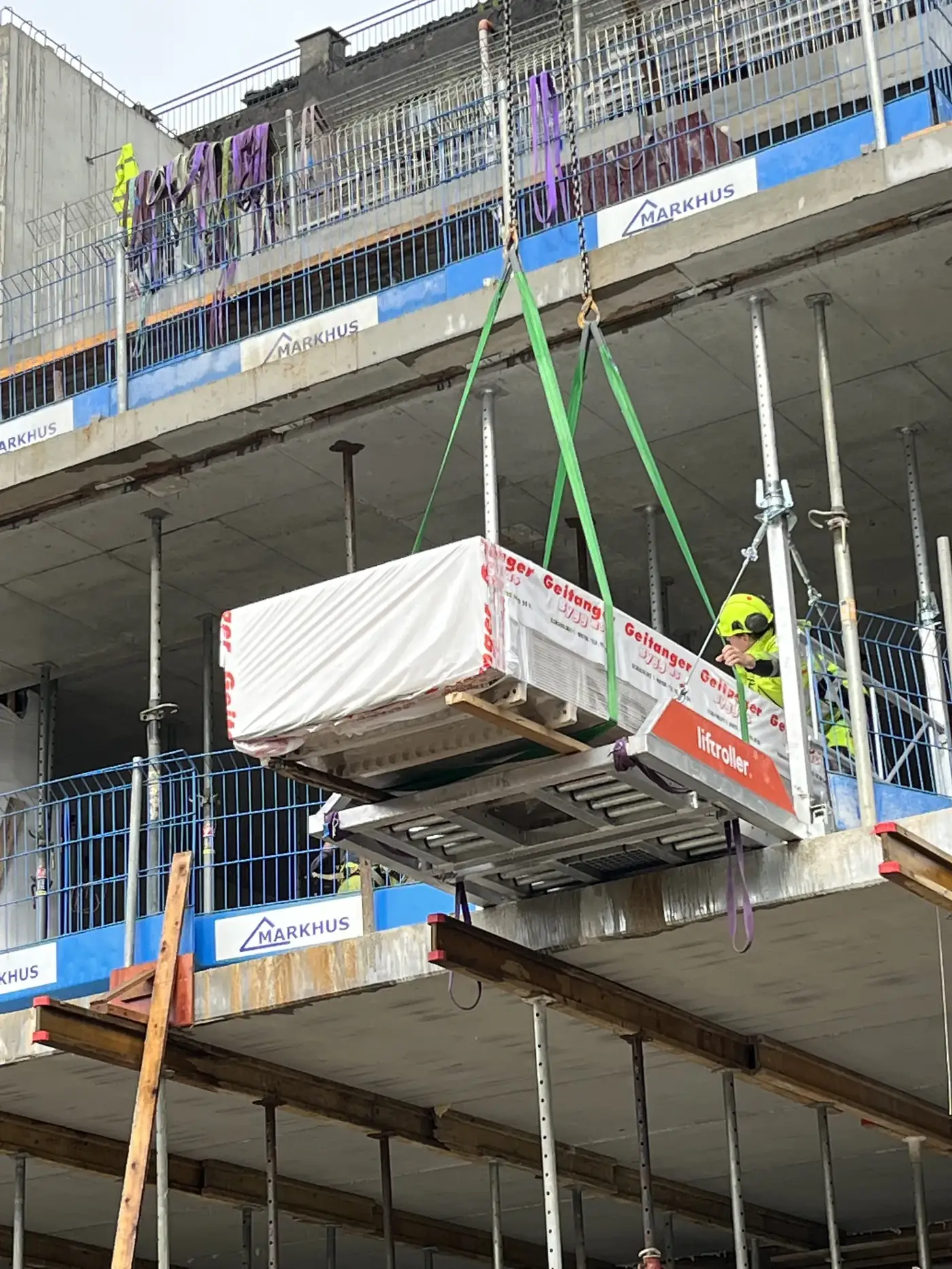
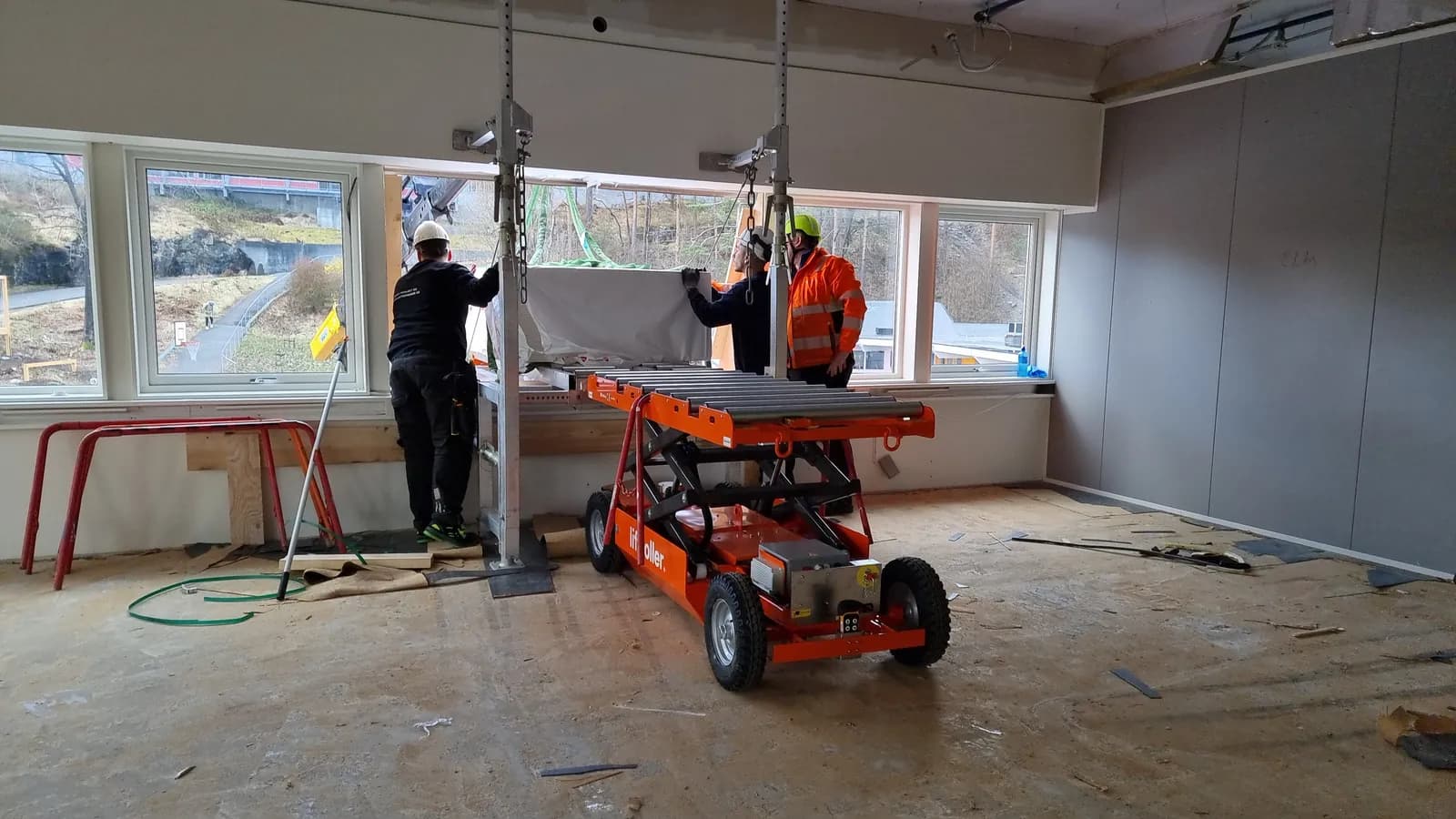
The Liftroller Wall turns a window opening into a loading dock. It sits in the aperture, clamps between the floor and the ceiling, and extends a roller bed out past the facade. The crane lands a pack on the outer rollers and one or two people roll it inside. No carrying, no passing sheets through by hand.
It is built mostly from aluminium, so the parts can be carried up a stairwell and put together on the floor where they are needed. The patented clamping system holds it in place against the wall without fixings, which means no drilling into the facade and no making good afterwards. On refurbishment work that matters, because you use the openings the building already has rather than cutting one.
Because it is not classified as scaffolding or as a lifting appliance, your own crew can assemble and use it. There is no requirement for a certified installer to put it up.
How it works on site
- 1
Carry the parts to the floor
The Wall breaks down into manageable aluminium sections. Two people can carry it up a stairwell, so it works on floors a lift will not reach.
- 2
Clamp it into the opening
The unit adjusts to the window width and tensions between the floor slab and the ceiling. No tools, no fixings, nothing drilled into the facade.
- 3
Land the load on the outer rollers
The crane sets the pack down on the section that projects outside the building. Rated to 1,200 kg, so a full pallet of plasterboard is well inside its limit.
- 4
Roll it in and away
The bed slopes inwards so the load runs into the building rather than out of it. From there it goes onto a wagon, a stacker or a run of tables, and out to where it is being fixed.
What goes through the window
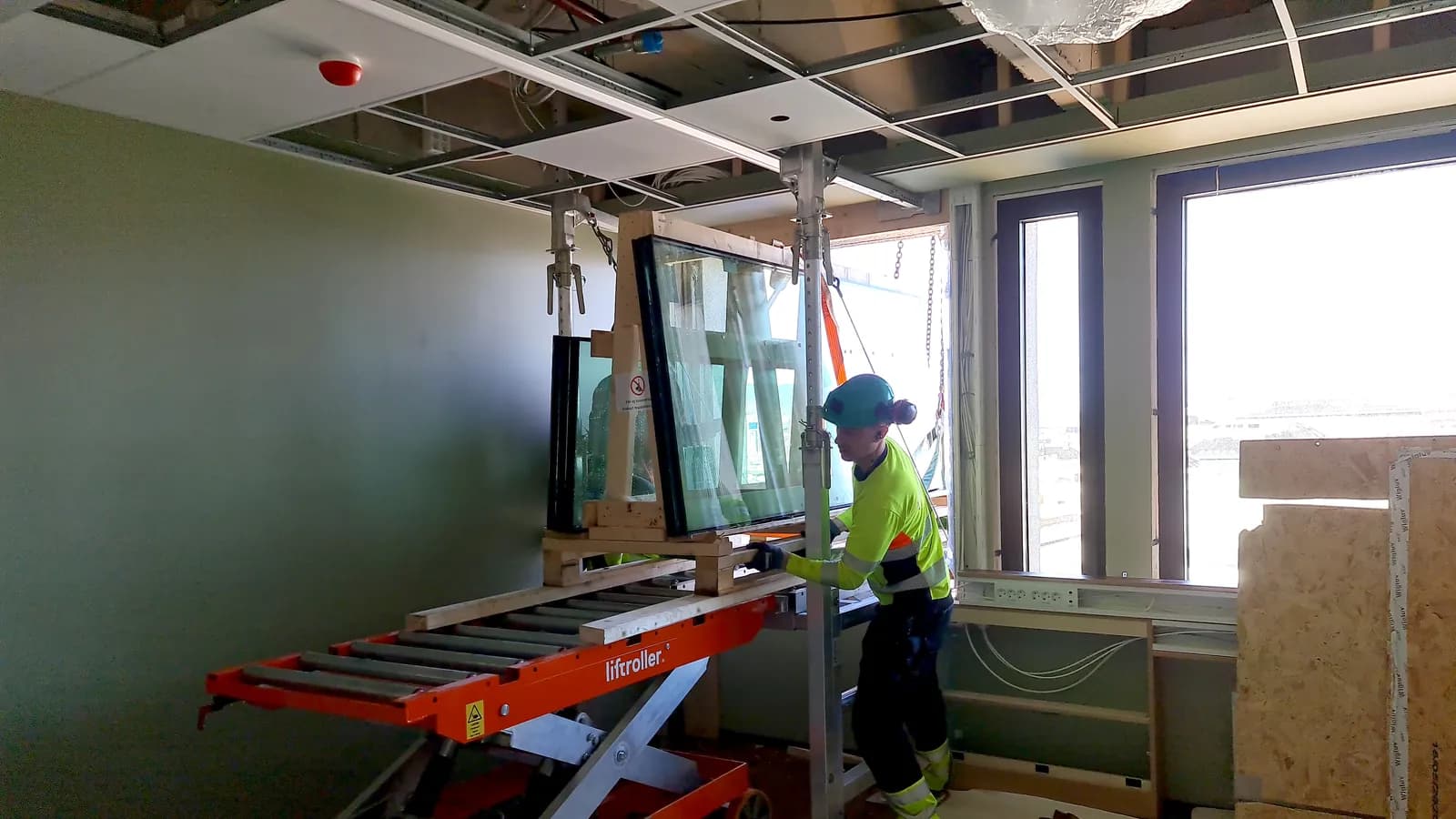
If it fits through the opening, it goes on the rollers. Because the bed is a flat roller line rather than a cage, it takes long and awkward loads that other equipment struggles with.
- Plasterboard and Gyprock, by the pack
- Bathroom tiles and stone on pallets
- Kitchen and joinery modules
- Interior glass and partition systems
- Ventilation ductwork and plant
- Timber studs, framing and doors
- Carpet and vinyl rolls
- Steel beams and long sections
- Big bags of strip-out waste, going the other way
In less than an hour, we hauled more than 12 tonnes of plasterboard through the window.
Technical specifications
Every figure below was verified against the manufacturer's Australian specification sheets in August 2026.
| Specification | Value |
|---|---|
| Minimum window width | 900 mm |
| Maximum width loading area | 990 mm |
| Maximum wall thickness | 500 mm |
| Minimum ceiling height | 2150 mm |
| Maximum ceiling height | 3900 mm |
| Minimum height roller table | 930 mm |
| Maximum height roller table | 1225 mm |
| Maximum parapet height | 1050 mm |
| Tare weight total | 177 kg |
| Max. load capacity (WLL) | 1200 kg |
Key features
- Carries up to 1,200kg on all three models
- Fits window openings from 900mm wide
- Assembles in 10 to 15 minutes with no tools
- Clamps between floor and ceiling, no fixings in the facade
- Not classed as scaffolding or a lifting appliance
- Aluminium, so it can be carried up a stairwell
Which model do you need
Parts from each model can be combined and custom versions are available. Tell us your opening widths, wall thickness and floor-to-ceiling height and we will tell you which one fits.
Narrow
Tighter openings, from 900 mm wide.
- Minimum window width
- 900 mm
- Maximum loading width
- 990 mm
- Maximum wall thickness
- 500 mm
- Ceiling height range
- 2,150 to 3,900 mm
- Tare weight
- 177 kg
Standard
The usual choice on new build and most fitouts.
- Minimum window width
- 1,200 mm
- Maximum loading width
- 1,550 mm
- Maximum wall thickness
- 500 mm
- Ceiling height range
- 2,150 to 3,900 mm
- Tare weight
- 187 kg
Extended
Thick masonry walls and high ceilings, typical of older buildings.
- Minimum window width
- 1,200 mm
- Maximum loading width
- 1,500 mm
- Maximum wall thickness
- 800 mm
- Ceiling height range
- 2,950 to 4,700 mm
- Tare weight
- 197 kg
See it working
Got a question about your site?
Openings, floor levels, load weights: send us the details and we'll tell you straight whether the Liftroller Wall is the right call.
Where it is used
Apartment and hotel fitouts
Plasterboard, tiles, kitchen modules and bathroom pods land on the right floor instead of the ground, so nothing gets double-handled up a stairwell.
Heritage and refurbishment
You use the existing windows. No cutting the facade open, no scaffold licence, and no making good a hole in a listed elevation afterwards.
Tight city sites
Nothing stands on the ground taking up rigging space, which matters when the site boundary is the footpath.
Getting waste out
The rollers run both directions. Load big bags of offcuts and strip-out waste and crane them off, so the floor stays clear without a bin on the ground.
Wall, Floor, or an external hoist
Three ways to get materials to an upper floor. Which one you can use is usually decided by the opening you have and the space on the ground.

| Attribute | Liftroller Wall | Liftroller Floor | Cantilever loading bay |
|---|---|---|---|
| Working load limit | 1,200 kg | 1,500 kg | Varies by design |
| Needs scaffold or ground space | No | No | Yes |
| Fixings or ties into the building | No | No | Yes |
| Suits a window with a sill | Yes | No | Yes |
| Suits a floor-to-ceiling opening | No | Yes | Yes |
| Rollers, so loads move without lifting | Yes | Yes | No |
| Pallet jack drives onto the deck | No | Yes | No |
| Erected by your own crew | Yes | Yes | No |
| Typical setup time | 10 to 15 min | Similar | Longer, and scheduled |
| Moved to another floor by two people | Yes | Yes | No |
Choose Liftroller Wall when
You are loading through a window or an opening with a sill or parapet under it.
Choose Liftroller Floor when
The opening runs all the way down to the slab, and you want a pallet jack on the deck.
Choose Cantilever loading bay when
You already have scaffold up, the bay can stay in one place, and you have a licensed crew to erect it.
The loading bay column describes that class of equipment in general, not one named product, and erection requirements vary by system and state. Check the specific system and your own scaffolding requirements. Other ways people solve this: an external material hoist, craning to ground level and carrying up, or a telehandler where there is room for one.
Want Liftroller Wall pricing for your site?
Leave your details and we'll call you back with availability and what it costs for your job.
Working out whether it pays
We are not going to put a savings figure on this page that we cannot stand behind. What we can do is tell you which lines to add up, because on most jobs the answer is obvious once they are written down.
Labour hours on material handling
Count the people and the hours currently spent carrying, and what those hours are worth on your rates. This is usually the biggest line by a distance.
Crane and hoist time
Every lift to ground level that then has to be moved again is a lift you paid for twice. Landing on the floor removes the second handling.
The goods lift
If materials are going up in the lift, other trades are waiting for it. Freeing the lift has a programme cost attached that rarely gets counted.
Rigging and ground space
External hoists and scaffold bays need somewhere to stand and something to tie to. On a tight site that space has a real cost, or does not exist at all.
Damage and rework
Carried materials get dropped, scuffed and cornered. Sheets rolling on a level bed do not.
Injury and lost time
Manual handling is one of the largest causes of lost-time injury in Australian construction. Fewer carried loads is fewer chances for a back injury on your job.
Price it against what you currently spend getting materials to the floor for the duration of the job, not against the day rate on its own. If you want help doing that sum for your site, send us the details and we will work through it with you.
Common questions
It is a mobile loading platform with rollers that fits into an existing window or facade opening. It forms a conveyor between the outside of the building and the floor inside, so materials can be craned in at height rather than carried up.
The working load limit is 1,200 kg on all three models, Narrow, Standard and Extended. A full pack of plasterboard sits comfortably inside that.
Around 10 to 15 minutes once your crew has done it a few times. It needs no tools and no fixings.
No. It clamps between the floor and the ceiling and holds against the wall with a patented locking system. Nothing is drilled into the facade, so there is no making good when it comes out.
No. The Liftroller Wall is not classed as scaffolding or as a lifting appliance, so your own crew can assemble and use it. Confirm your own site requirements and safe work method statement as usual.
The Narrow model starts at a 900 mm window width. The Standard and Extended models need at least 1,200 mm. For openings wider than 1,700 mm, talk to us about on-site adaptions.
The Narrow and Standard models handle walls up to 500 mm thick. The Extended model goes to 800 mm, which covers most older brick construction.
Yes. Liftroller Australia supplies and hires the full range from Hillsdale in Sydney. Get in touch with the floor levels, opening sizes and the loads you need to move and we will tell you which model fits.
Not covered here? Talk to our team and we will answer it against your actual site.
Works with
The Liftroller range is a system. These are the pieces most often used alongside this one.


Hire or buy
Let's work out if the Liftroller Wall fits
Send us the loads, the access and your dates. You'll get a person who knows the gear, not a sales script, and a straight answer on whether this is the right machine for the job.
A real reply, usually same day
Weekdays, from the team in Sydney. Not an autoresponder.
We'll tell you if it's the wrong fit
If another machine in the range suits your access better, we'll say so.
Under a minute to fill
Name, email and a number so we can call you back. Everything else is optional.
Liftroller Wall
Get pricing and availability