Roller Systems
Liftroller Table roller conveyor
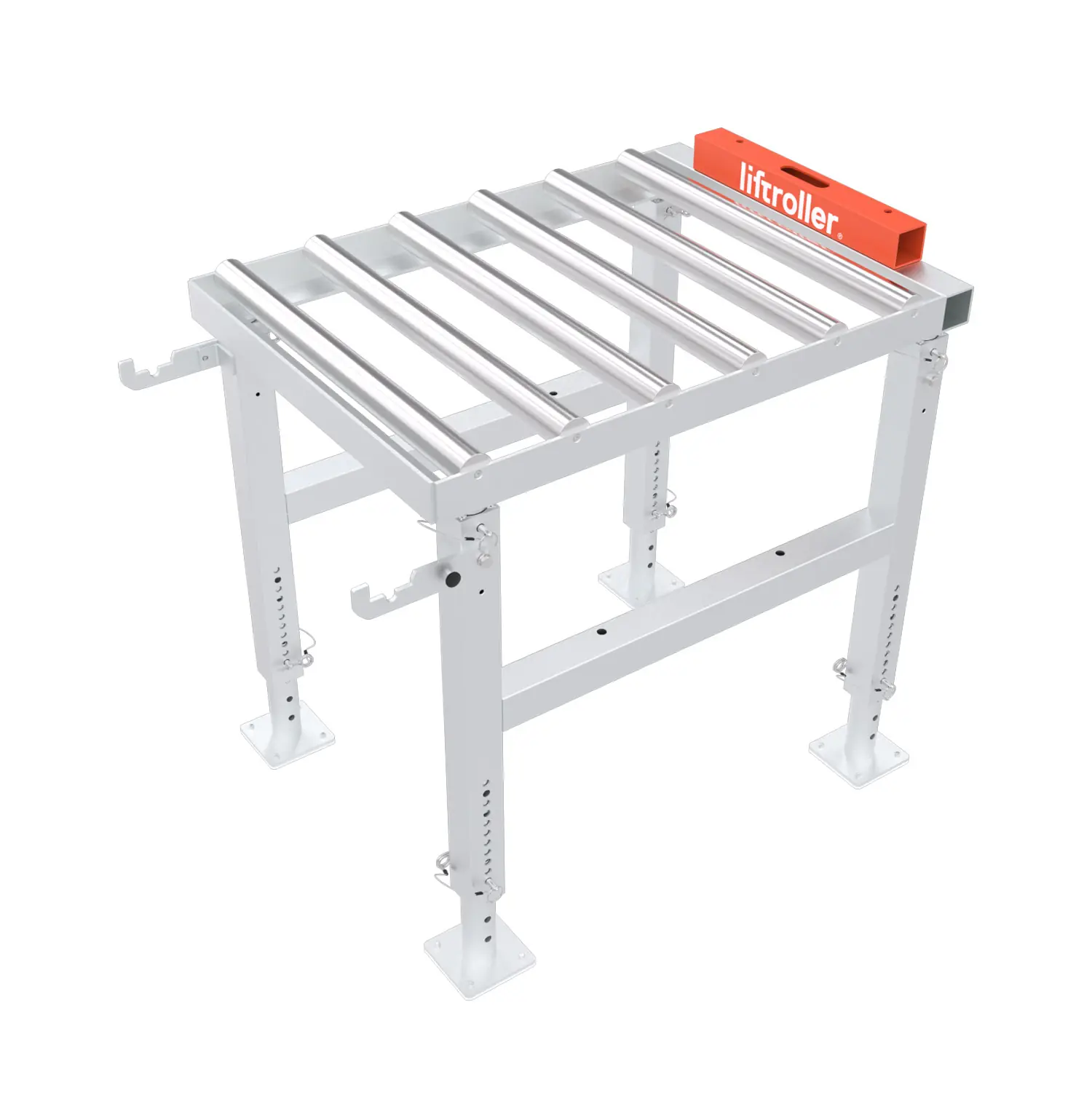
The Liftroller Table is an aluminium gravity roller conveyor that extends the run from a Liftroller Wall further into a building. Each table carries 1,200 kg, they connect end to end to reach as far as you need, and the adjustable legs set the fall so loads keep rolling inwards.
 1 / 7
1 / 7Talk to the team
Get pricing on the Liftroller Table
Tell us the floor levels, the openings you have and what you need to move. We'll come back with the right setup and what it costs.
A real reply, usually same day
Weekdays, from the team in Sydney. Not an autoresponder.
We'll tell you if it's the wrong fit
If another machine in the range suits your access better, we'll say so.
Under a minute to fill
Name, email and a number so we can call you back. Everything else is optional.
What the Liftroller Table does
Sometimes there is no room for a trolley. Narrow passages, tight lobbies, a corridor with a turn in it. The Table solves that by extending the roller line itself, so the load keeps moving on rollers instead of being lifted onto a machine.
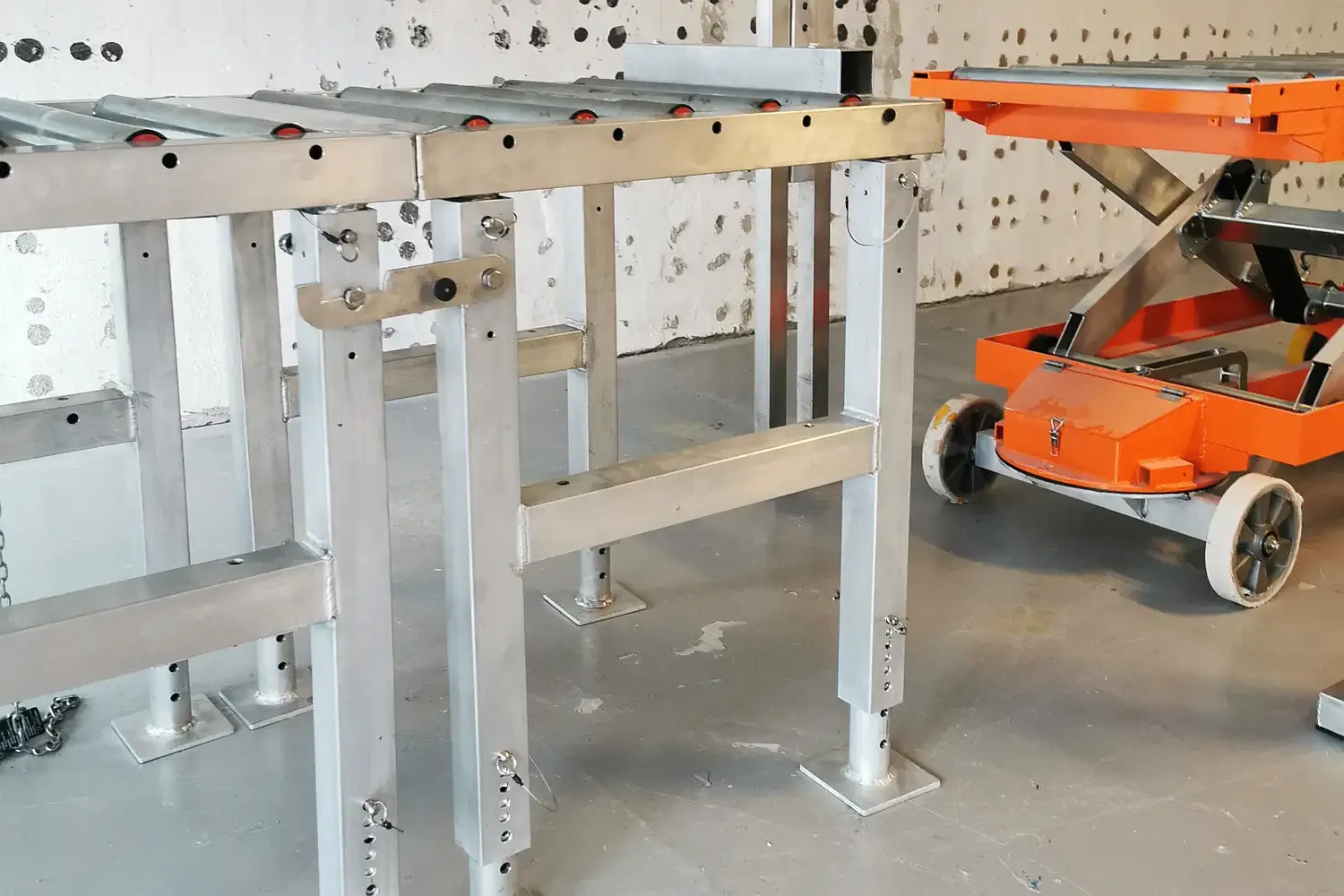
Tables connect to each other and can be run as far into the room as you need. The legs adjust so you can fine-tune the fall, which matters because the deck on the Liftroller Wall slopes inwards and the tables need to carry that slope through or the load stops.
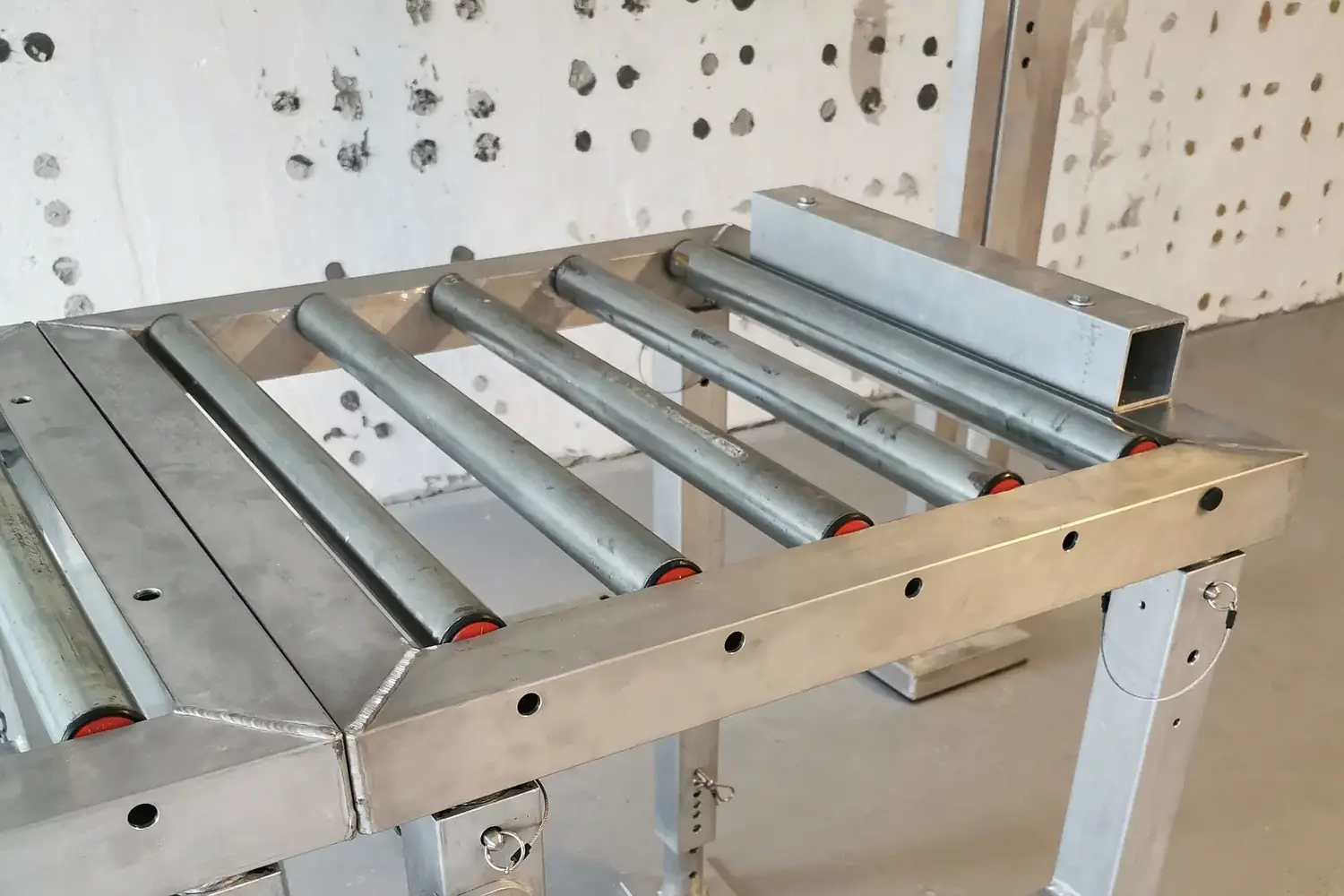
A load stopper goes on the last table so nothing runs off the end. The whole thing is aluminium, comes as separate components and goes together in about five minutes without tools.
How it works on site
- 1
Set the first table against the platform
Adjust the legs so the deck height matches the Liftroller Wall, between 930 mm and 1,225 mm.
- 2
Add tables to reach
They clip to each other. Add as many as the run needs.
- 3
Set the fall
Fine-tune the legs so the line keeps a slight slope inwards. That is what keeps the load rolling without being pushed.
- 4
Fit the load stopper
On the final table, so the pack stops where you want it rather than at the far wall.
What runs along it
Anything that will sit on a roller bed. The tables come into their own where a machine cannot fit or cannot turn.
- Plasterboard packs
- Long timber and steel sections
- Carpet and vinyl rolls
- Boxed and palletised goods
- Waste heading back to the loading point
Technical specifications
Every figure below was verified against the manufacturer's Australian specification sheets in August 2026.
| Specification | Value |
|---|---|
| Minimum height roller table | 930 mm |
| Maximum height roller table | 1255 mm |
| Width roller table | 800 mm |
| Length roller table (Table 80 / 110) | 800 / 1100 mm |
| Tare weight (Table 80 / 110) | 47 / 59 kg |
| Max. load capacity (WLL) | 1200 kg |
Key features
- Carries up to 1,200kg per table
- Extends the Liftroller Wall conveyor line into the building
- Connects to more tables and extends as far as needed
- Adjustable legs to set the correct incline
- Load stopper included to secure the load
- Lightweight aluminium, assembles in about 5 minutes, no tools
Which model do you need
Two lengths, both 800 mm wide and both rated to 1,200 kg. The number in the name is the length in centimetres, so the Table 80 is 800 mm long and the Table 110 is 1,100 mm. Mix them to suit the run.
Table 80 (800 mm)
The standard length. Most runs are built from these.
- Length
- 800 mm
- Width
- 800 mm
- Tare weight
- 47 kg
- Working load limit
- 1,200 kg
Table 110 (1,100 mm)
The longer table. Covers more distance with fewer joins.
- Length
- 1,100 mm
- Width
- 800 mm
- Tare weight
- 59 kg
- Working load limit
- 1,200 kg
See it working
Got a question about your site?
Openings, floor levels, load weights: send us the details and we'll tell you straight whether the Liftroller Table is the right call.
Where it is used
Narrow passages
Where a goods trolley will not fit or cannot turn, the roller line goes through instead.
Short runs
When the work face is only a few metres in, a run of tables is quicker to set up than bringing a machine to the floor.
Feeding a trolley further in
Run the line past the pinch point and load a wagon on the other side of it.
Getting waste back out
The line works both directions, so offcuts travel back to the loading point the same way.
Tables or a goods trolley
Once the load is inside, it either rolls or it rides. The layout of the floor usually decides which.
This page
Liftroller Table

| Attribute | Liftroller Table | Liftroller Wagon or E Wagon |
|---|---|---|
| Load capacity | 1,200 kg per table | 1,200 kg |
| Own weight | 47 kg or 59 kg | 230 to 570 kg |
| Needs floor space to turn | No | Yes |
| Works in a narrow passage | Yes | No |
| Distance covered | As many tables as you add | Unlimited across a floor |
| Setup time | About 5 min per table | Ready to go |
| Needs power | No | E Wagon does |
| Carried up a stairwell | yes, easily | Wagon yes, E Wagon no |
Choose Liftroller Table when
Short runs, narrow passages, and pinch points where a machine cannot fit or turn.
Choose Liftroller Wagon or E Wagon when
Longer distances across an open floor, and loads that need repositioning all day.
Want Liftroller Table pricing for your site?
Leave your details and we'll call you back with availability and what it costs for your job.
Working out whether it pays
Tables are the cheapest way to extend a roller line, so the comparison is usually against hiring a second trolley or carrying the last few metres.
Labour hours on material handling
Count the people and the hours currently spent carrying, and what those hours are worth on your rates. This is usually the biggest line by a distance.
Crane and hoist time
Every lift to ground level that then has to be moved again is a lift you paid for twice. Landing on the floor removes the second handling.
The goods lift
If materials are going up in the lift, other trades are waiting for it. Freeing the lift has a programme cost attached that rarely gets counted.
Rigging and ground space
External hoists and scaffold bays need somewhere to stand and something to tie to. On a tight site that space has a real cost, or does not exist at all.
Damage and rework
Carried materials get dropped, scuffed and cornered. Sheets rolling on a level bed do not.
Injury and lost time
Manual handling is one of the largest causes of lost-time injury in Australian construction. Fewer carried loads is fewer chances for a back injury on your job.
Tell us the distance from the opening to the work face and any pinch points on the way, and we will tell you how many tables the run needs.
Common questions
It is an aluminium gravity roller conveyor table that extends the roller line from a Liftroller Wall further into a building. Each one carries 1,200 kg.
1,200 kg per table.
As many as the run needs. They connect to each other and can be extended as far into the room as you want, with a load stopper on the last one.
About five minutes per table, with no tools. They arrive as separate components.
Two. The Table 80 is 800 mm long and weighs 47 kg. The Table 110 is 1,100 mm long and weighs 59 kg. Both are 800 mm wide and both carry 1,200 kg.
Not if the fall is set right. The adjustable legs let you carry the slope through from the platform so gravity does the work.
Not covered here? Talk to our team and we will answer it against your actual site.
Works with
The Liftroller range is a system. These are the pieces most often used alongside this one.


Hire or buy
Let's work out if the Liftroller Table fits
Send us the loads, the access and your dates. You'll get a person who knows the gear, not a sales script, and a straight answer on whether this is the right machine for the job.
A real reply, usually same day
Weekdays, from the team in Sydney. Not an autoresponder.
We'll tell you if it's the wrong fit
If another machine in the range suits your access better, we'll say so.
Under a minute to fill
Name, email and a number so we can call you back. Everything else is optional.
Liftroller Table
Get pricing and availability