City Centre Fit-Out Logistics Cheat Sheet: The Complete Contractors' Guide

Get a quote for your site
Leave your details and we'll call you back with pricing and the right system for the job.
Most fit-out overruns in a city centre are not caused by the work. They are caused by material sitting in the wrong place, arriving at the wrong time, or not getting through the door. Get the logistics right and the trades get on with it.
This is the checklist we would want in front of us before pricing an urban fit-out.
Before you start
Measure the access, all of it
Doorways, corridors, lift car dimensions, lift door openings, stairwell widths, turning circles at every corner. Write them down. Then check the two things that catch people out: the weight limit of the lift, and the floor loading capacity of each level.
Both of those turn into delays if you find them late, because by then the material is already on a truck.
Find your delivery windows early
Most city centres restrict when you can deliver, and a window of 7 am to 10 am is common. That window sets your whole day, so establish it before you build the programme rather than after.
Map parking restrictions and loading bay availability around the site while you are at it. Then go and talk to the neighbouring businesses. Ten minutes at the start buys you goodwill you will need later.
Permits
Permits are the item most likely to move your start date. You will usually need some combination of:
- road closure permits for large deliveries or crane access
- parking suspensions for material storage and site parking
- noise permits for any work outside standard hours
- waste management permits for skip placement
- scaffolding licences for external access
Every local authority does it differently, so start the process well before you think you need to.
 The Opus XVI hotel remodelling in Bergen. A protected facade and a live street set the rules for the whole job.
Moving material vertically
The goods lift in an existing building was designed for the building's daily use, not for a fit-out. It will be the bottleneck.
Temporary hoists suit multi-floor work where you have external access. They handle up to 2,000 kg, usually take 1 to 2 days to set up, and run somewhere around AUD$1,552 to AUD$2,910 per week.
Loading decks put the material on the floor that needs it rather than at ground level. The Liftroller Floor carries up to 1,500 kg, comes apart onto a EUR pallet so it can be carried up by hand, and sits with its rollers 85 mm off the floor so a pallet jack runs straight off it. If you have a crane on site anyway, this takes a lot of trips off the hoist. There is more detail in our guide to cantilevered loading platforms.
Track based and motorised systems get into spaces that stop conventional equipment. They cut the manual handling out of repetitive lifting, which is most of what a fit-out is.
Traditional methods still matter. Manual handling teams for small items, pallet trucks for ground floor distribution, stair climbers for moderate loads. Do not over-engineer a job that does not need it.
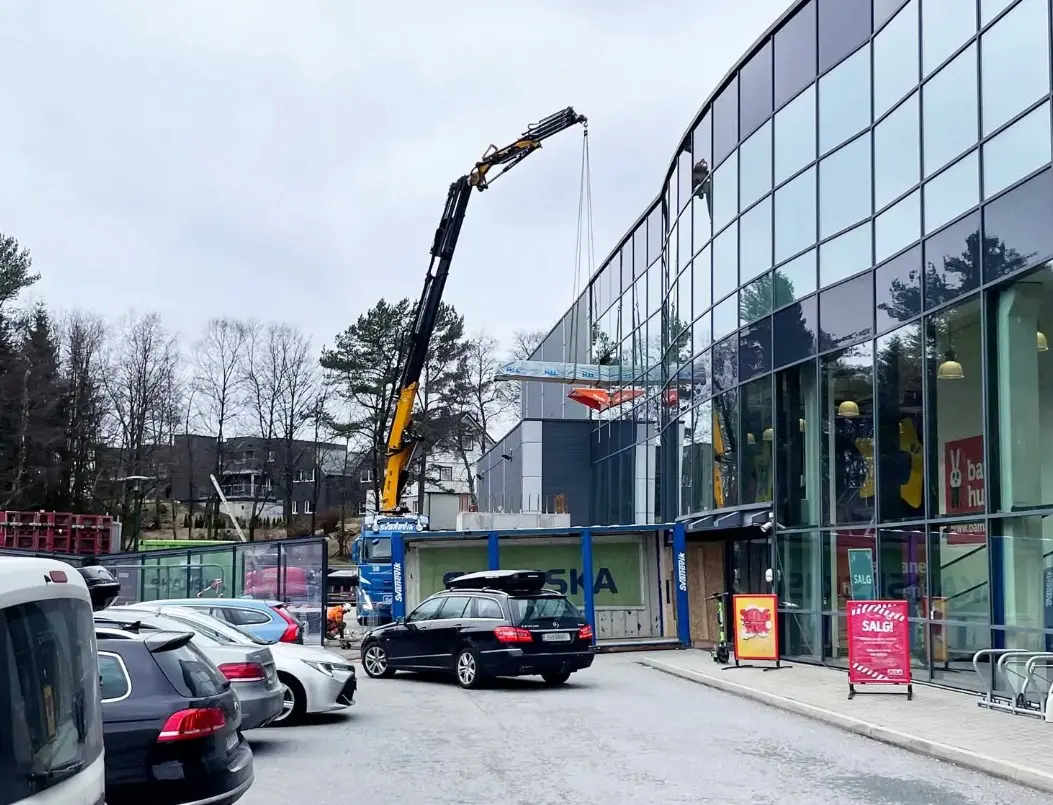 Skanska converting retail space in Norway. Loading through the facade kept the shopfront and the car park working.
Moving material horizontally
Once material is on the right floor it still has to reach the work front, and this is where the hours quietly disappear.
For open floor plates, the Liftroller Wagon or the powered E Wagon covers distance without tying up three people per load. Both carry up to 1,200 kg.
For tight interior work through standard doorways and around existing corners, the E Mover is the compact version. 8Build ran one on a Waterloo refurbishment and reported a 60 per cent cut in material handling time, which is written up in the 8Build trial.
Where you need to lift and stack rather than carry, the Liftroller Stacker handles up to 1,000 kg.
Just in time delivery
Line deliveries up with the installation programme instead of trying to store everything on site. On an urban job you almost certainly cannot store it anyway.
Agree flexible delivery arrangements with suppliers up front. If you can get a holding area outside the city centre, use it as a consolidation centre: several supplier deliveries merged into one site delivery. That cuts the number of vehicles and makes far better use of a narrow delivery window.
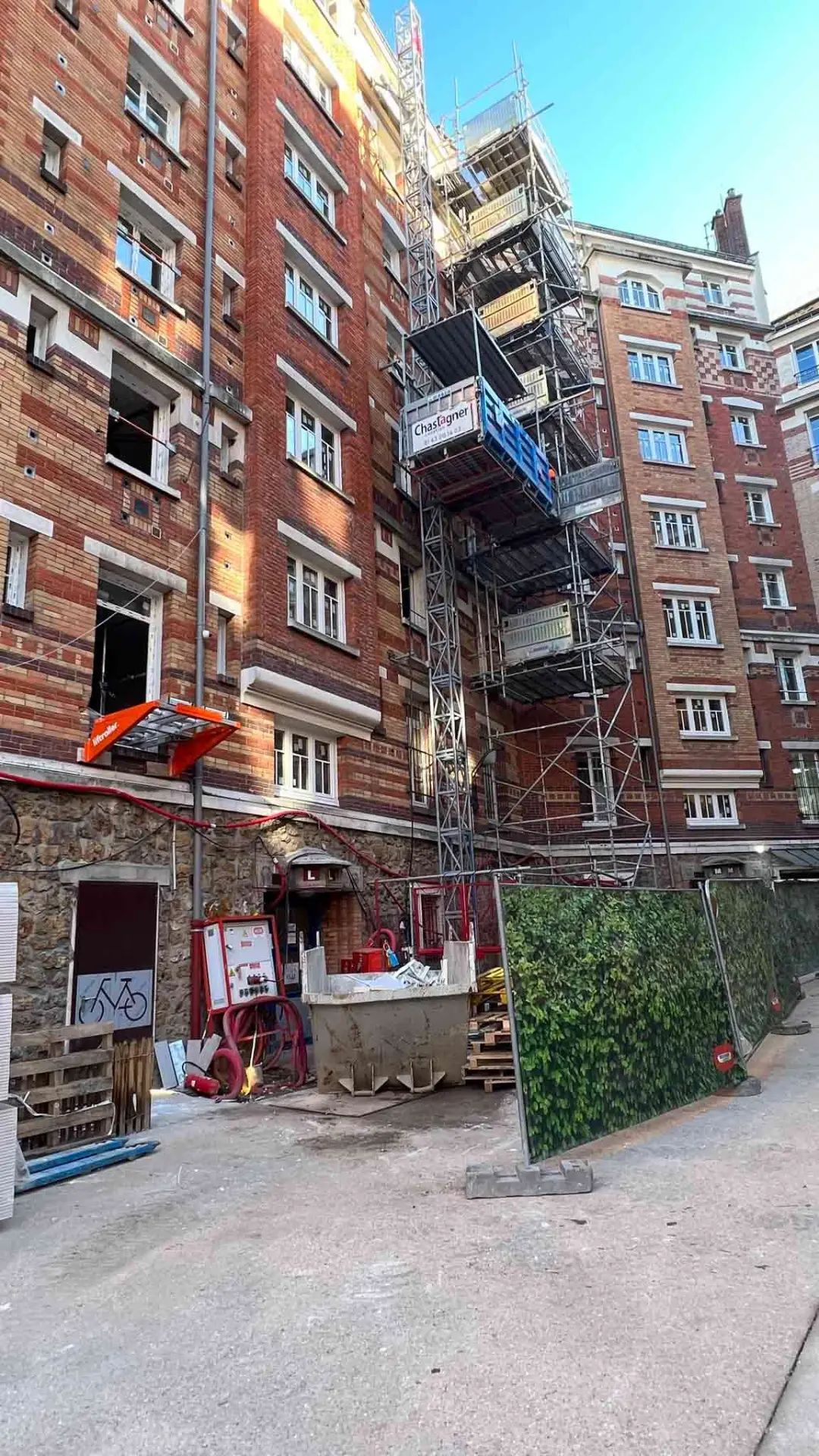 Renovating 450 apartments in Paris with barely any room at ground level to stage material.
Equipment that actually fits
Standard plant often will not get through a city centre access point. Plan around the opening, not the catalogue.
- Mini excavators under 1.5 tonnes for demolition
- Compact concrete mixers that go through a standard doorway
- Portable dust extraction for environmental compliance
- Low profile trolleys for tight corners
On power tools, battery kit removes cable hazards in busy areas and saves a lot of arguing about trip risk. Most city centres will expect dust suppression, so budget for it rather than bolting it on later. Electric power banks in place of diesel generators will also cut down the noise complaints from neighbours.
People
Shift planning. Early starts between 6 am and 7 am let you use the quieter delivery windows. Staggered breaks help with building management and shared access.
Parking. Getting vans and cars into a city centre is a constant cost and a constant argument. Public transport incentives or a shuttle from parking outside the centre usually work out cheaper than fighting it.
Safety. Managing pedestrians near the work area comes first. Anything that reduces material being moved across an open edge or through a public route reduces that risk, which is why loading through the facade is worth considering. Skanska took that approach when they converted retail spaces using Liftroller Wall.
Emergency evacuation procedures need to be clear in multi-occupancy buildings, and site conditions change often enough on an urban job that briefings need to be regular rather than one-off.
Weighing up Liftroller for a job?
Leave your details and we'll call you back with pricing and the right system for the load.
Storage and staging
On site. Secure compounds are hard to find in a city centre. Go vertical to make the most of limited floor space. Climate controlled storage matters for sensitive materials, and segregating storage by trade stops crews digging through each other's material.
Off site. Storage outside the centre with daily deliveries often beats paying city centre rates. Mobile storage units give you flexibility because you can move them as the job progresses, and supplier managed inventory cuts what you need to hold at all.
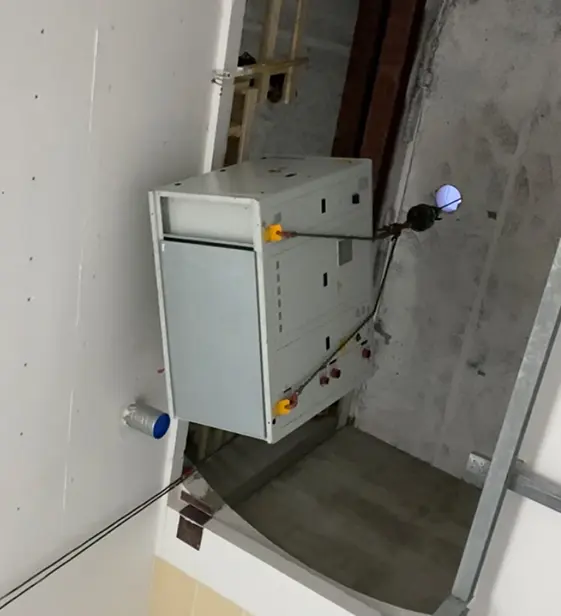 Staging inside the building on the former US embassy refurbishment in Oslo.
Common problems and what to do about them
Limited lift capacity. Break large items down before delivery, use specialist lifting equipment, or hoist oversized items externally. Plan the workaround before you need it.
Restricted delivery windows. Negotiate longer hours with the local authority where you can, use overnight storage, and set up weekend schedules. Have a second option ready, because the first one often falls over.
Dust and noise. Good extraction, noisy work scheduled inside permitted hours, and a working relationship with the neighbours. The third one is worth more than the first two.
Waste. Segregated streams, compactors to cut volume, and regular collections booked inside permitted hours. Miss a collection slot in a city centre and you can be waiting a full week for the next one.
Money
Allow an extra 15 to 20 per cent for logistics compared with a project outside the centre. The overruns usually come from two places: storage fees on long programmes, and delays caused by permits and access.
Specialist urban contractors charge more per hour and often finish sooner. On a constrained site that trade is frequently worth making.
Things that genuinely save money:
- bulk deliveries during any extended access window, which cuts your per unit cost
- an out of town storage area instead of paying city centre rates
- sharing resources with other contractors in the same building
The bigger saving is usually in labour hours rather than hire rates. Our cost savings breakdown sets out how to work that through for your own job.
Relationships
Building management control access and facilities. Keep them on side.
Local authorities control permits and compliance. Ask early, ask politely.
Neighbouring businesses can make your operation easy or very hard. That is largely up to how you treat them in week one.
Suppliers who understand urban work give better information and more flexibility than the cheapest quote will.
Give everyone regular updates on progress and likely disruption, agree how urgent issues get escalated, and deal with problems before they arrive rather than after.
Contingency
Work out alternative access routes before a primary route is blocked. Keep backup suppliers warm for critical materials. Keep emergency contact lists current for every stakeholder. Have a response plan for equipment failure, because in a city centre a half day delay turns into a week very quickly.
For bigger disruptions, agree the communication lines in advance, check your insurance actually covers city specific risks, and keep a business continuity plan for a long delay.
Final checklist
Before you start
- all permits obtained and displayed correctly
- site access confirmed and every measurement verified
- delivery schedules agreed with all suppliers
- workforce briefed on urban specific procedures
- emergency procedures communicated to all parties
Every day
- keep to the delivery windows without exception
- monitor noise and dust
- follow the waste protocols
- update stakeholders on progress
- service equipment on schedule, not after it breaks
At completion
- waste cleared on time and the site returned to its original state
- final inspections done and permits closed out with the authorities
- feedback gathered from stakeholders for the next job
For the Sydney version of these constraints, including council road occupancy and heritage conditions, see loading platforms on Sydney sites. The landing method itself is covered in loading platform hire in Australia, and scaffold loading bay alternatives deals with the case where the scaffold comes down before the fit-out finishes.
Get the material handling right first
Everything above is easier when material stops being moved by hand more times than it needs to be. Tell us the building, the access dimensions and the heaviest thing you need to shift, and we will tell you what fits and what does not. Talk to our team and we will work it through with you.
Quick answers
Frequently asked questions
Access that was measured optimistically. A lift with a lower weight limit than assumed, or a corridor that will not take a full pallet, changes how every delivery has to be handled for the rest of the job. Measure everything before you price the work, including the lift car and the tightest corner on the route.
As early as you can, and earlier than feels necessary. Requirements differ by local authority and there is rarely a way to speed one up once you are in the queue. Treat permits as a programme item with its own dates rather than an admin task someone picks up later.
It depends on whether you have a crane on site and how often the work front moves. A hoist gives you continuous vertical movement without a crane. A loading deck takes fewer lifts and puts a full pallet straight onto the floor that needs it, and it can move up the building as the work does. Many jobs use both.
Reduce the number of times material is picked up. Land it as close to the work front as possible, then move it on a wagon rather than by hand. Most manual handling on a fit-out is not the initial lift, it is the third and fourth time the same pallet gets moved because it was put down in the wrong place.
Yes, if it is battery powered and quiet. The E Mover and E Wagon both charge from a standard 230V supply, with no exhaust and no fuel stored on the floor, which is usually what rules diesel plant out of an occupied block.
Around 15 to 20 per cent more than the equivalent project outside the city centre. Most of that goes on storage, restricted delivery windows and the labour hours lost to access. If you want a sharper number, work out how many times each pallet gets handled and cost that honestly.
Not always. It pays off when you have many suppliers, a narrow delivery window and no room on site. On a small job with a handful of deliveries the coordination overhead can outweigh the benefit, so run the numbers before committing to one.
Talk to our team about Liftroller
Tell us about your loads and access constraints and we'll recommend the right Liftroller setup. No obligation.
Related Articles
Loading Platform Hire in Australia: Types, Costs and How to Choose
The four ways to land material at height in Australia, what separates them, what actually drives the hire cost, and how to work out which one belongs on your site.
Loading Platforms on Sydney Sites: What Works in the CBD and Inner Suburbs
Road approvals, night work limits, heritage facades and the date your crane leaves site decide the landing method on a Sydney job. Here is what works where, from The Rocks to a Surry Hills warehouse conversion.
What Drives the Cost of Loading Platform Hire in Australia
The weekly rate is the smallest part of what you pay. Here is what actually moves a loading platform hire cost, and the six things to ask for so you can compare two quotes properly.