CantiDeck style Loading Platforms vs Liftroller Floor: Why Contractors Are Making the Switch
Get a quote for your site
Leave your details and we'll call you back with pricing and the right system for the job.
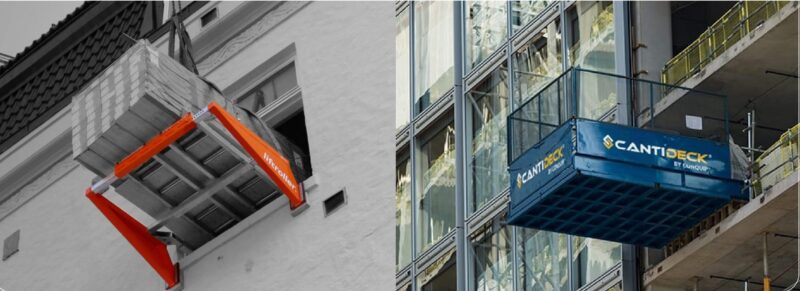
Two things land material on an upper floor: a fixed cantilevered deck bolted to the structure, or a lightweight system you carry up and wheel into place. Both work. They cost you in completely different places, and that is what decides which one belongs on your job.
Here is the honest comparison, including where the traditional deck still wins.
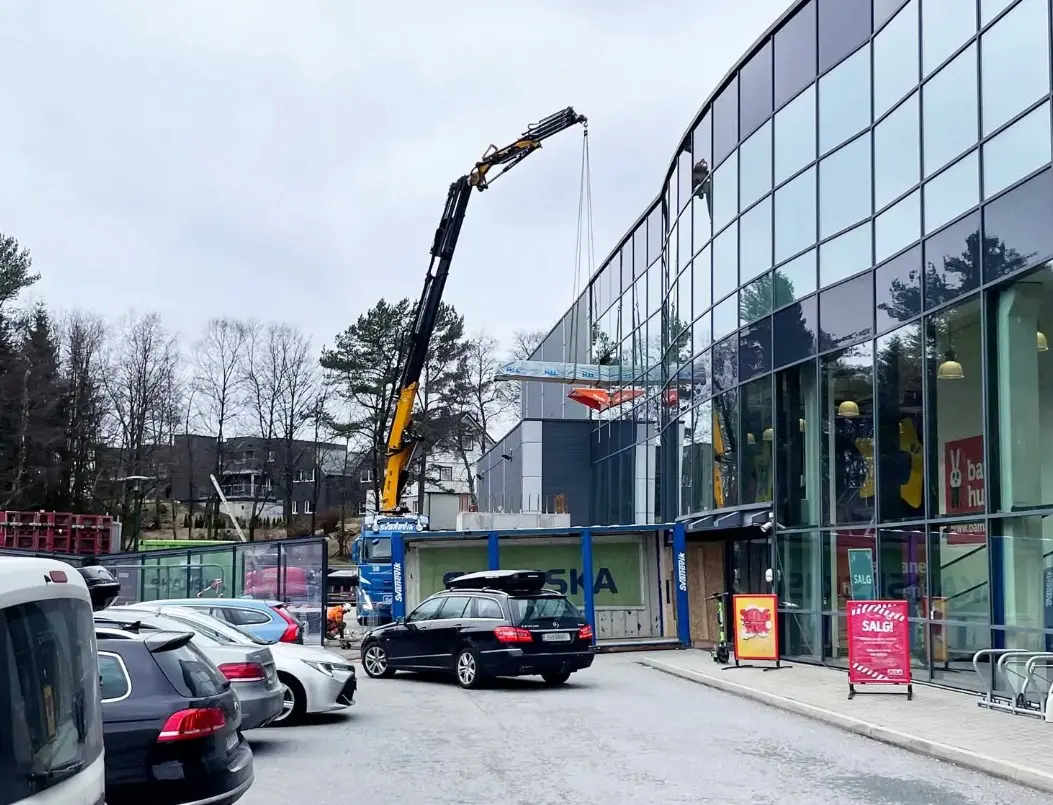 Skanska converting retail space in Norway. One crane lift straight into the level that needed it.
What a traditional cantilevered deck gives you
Cantilevered loading platforms have been on sites for decades because they do one thing extremely well. They give a crane a solid target at height, and they hold it for the whole programme.
The characteristics that come with that:
- Fixed position once installed. It goes where it goes, and it stays there.
- Loading and unloading is manual. The deck is a landing area, not a transport system. Getting the load from the deck to the work front is still on your crews.
- Lower upfront cost. For a single deck on a single job, the ticket price is usually lower.
- Standard safety detailing. Guardrails, mesh sides, load signage. The basics are well understood.
If you need one loading point in one place for the duration of a short job, that is a perfectly sensible choice. We say so plainly in our guide to cantilevered loading platforms.
What the Liftroller Floor does differently
The Liftroller Floor is the same idea built around a different constraint: what if you had to get the platform up the building without a crane?
The numbers behind that:
| Liftroller Floor | |
|---|---|
| Working load limit | 1,500 kg |
| Tare weight, complete | 259 kg |
| Length projecting outside the building | 1,300 mm |
| Length sitting inside the floor plate | 2,000 mm |
| Roller height above the floor | 85 mm |
| Track width for a pallet jack | 570 mm |
Three of those change how the job runs.
It comes apart onto a EUR pallet. Every component fits, so the whole system moves to and from site on normal transport. No specialised lifting equipment to get it there.
It gets carried to the floor it is needed on. Components go up by hand. That is the entire point. You are not booking a crane lift to reposition a loading point, which means moving up the building as the work front moves stops being an event.
It is assembled back from the edge and wheeled out. The ramp is on wheels, so crews build it at a safe distance from the slab edge and roll it into position. Nobody is working over an open edge while the thing is being put together.
Once it is in place, the rollers sit 85 mm off the floor with a 570 mm track for a pallet jack, so a load runs off the deck and onto the slab without being lifted over a lip.
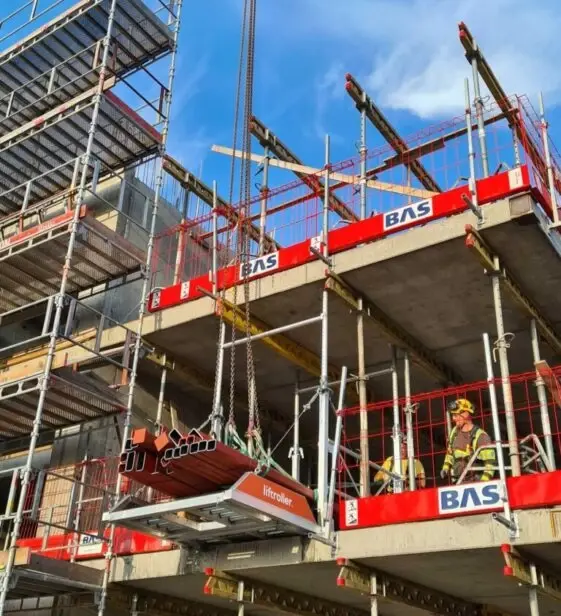 A crane lands the load. The deck is what turns that into material sitting where the trade needs it.
Weighing up Liftroller for a job?
Leave your details and we'll call you back with pricing and the right system for the load.
Head to head
Installation
A fixed deck is a structural install. It bolts to the frame, it needs the fixing detail checked against the slab, and moving it later is a job in itself.
The Liftroller Floor is carried up, assembled back from the edge and wheeled into position. Getting the setup right still matters and we recommend professional installation, but the effort scales with the number of decks rather than the number of crane bookings.
Moving between floors
This is where the two diverge most.
A fixed deck stays put. If the work front moves up three levels, you either live with the extra horizontal travel or you take the deck down and reinstall it.
A Liftroller Floor moves with the work. On a long programme that difference compounds every week.
Getting the load off the deck
Neither system moves material for you once it is inside. That is a separate problem, and it is usually the one that eats the hours.
On an open floor plate, a Liftroller Wagon or the powered E Wagon covers the distance. Through standard doorways and tight corners, the E Mover is the compact option. If you are stacking rather than carrying, the Stacker handles that end.
Cost
Upfront, a traditional deck is usually cheaper. Over a programme, the comparison changes, because the costs move into labour hours, crane time and repositioning rather than the purchase price.
We have broken the arithmetic down properly in our cost savings guide rather than asserting a percentage here. Run it against your own labour rates and crane costs, because those are the two numbers that decide it.
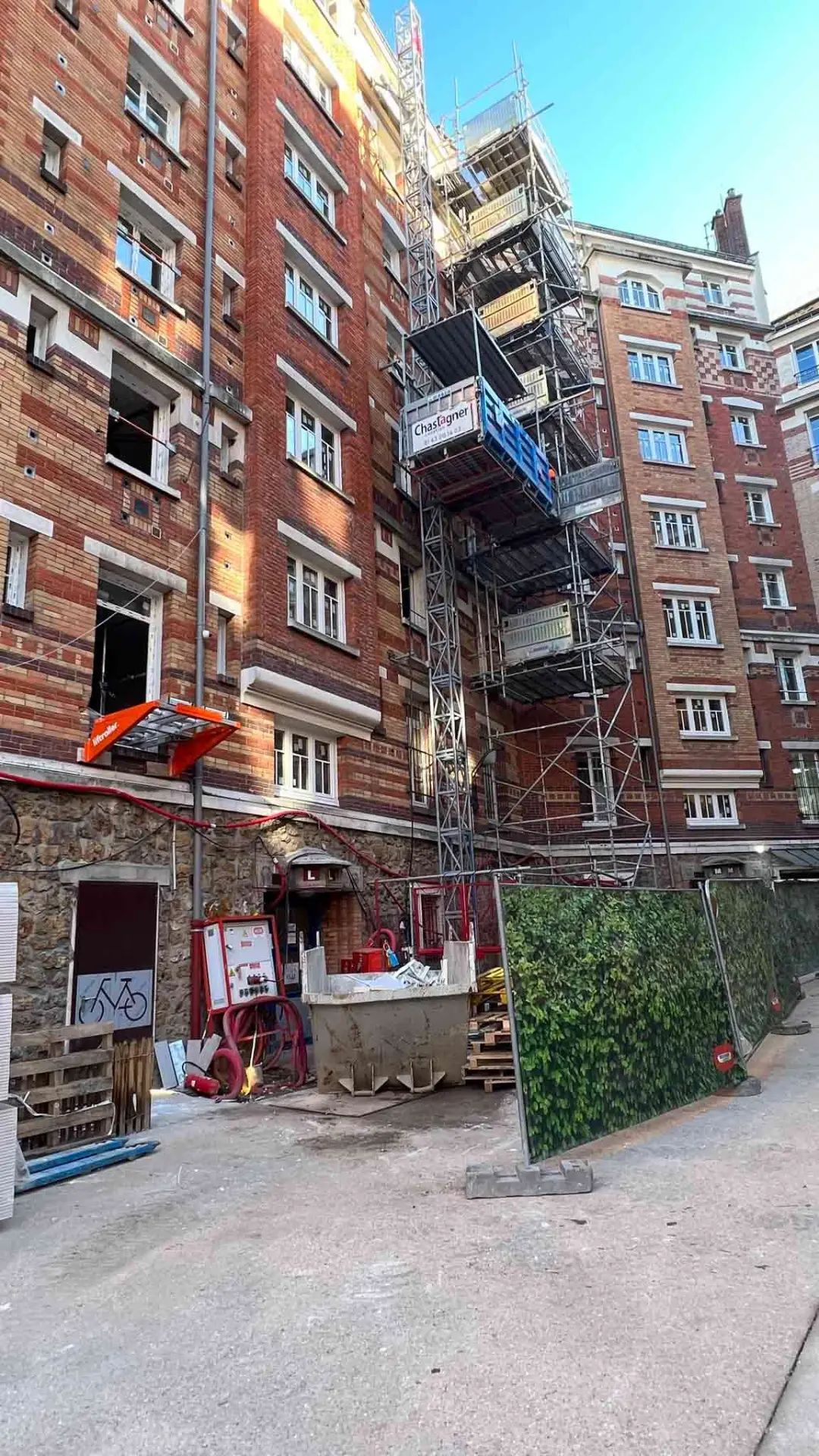 Renovating 450 apartments in Paris, where there was almost nowhere at ground level to put anything down.
How it has gone on real jobs
Skanska ran the Floor system on a build in Norway for the length of the programme. The write-up is on the Skanska Norway project page, and it is worth reading for the practical detail rather than the summary.
The Paris apartment renovation is the harder test. Four hundred and fifty apartments, an inner city courtyard, and almost no room at street level to stage anything.
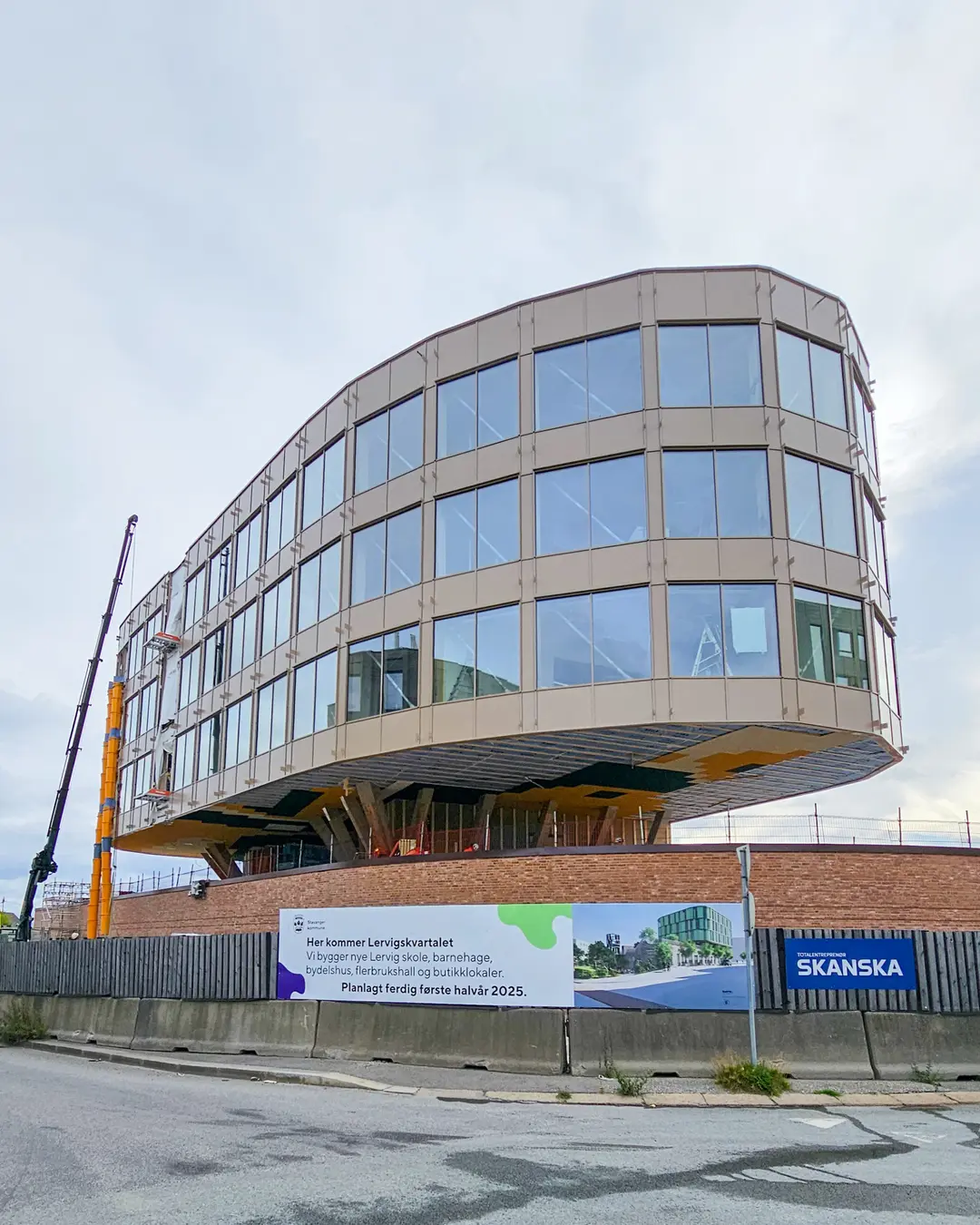 The Skanska project in Norway, where the Floor system ran for the length of the build.
Which one to pick
Go with a fixed cantilevered deck when you need one loading point in one place, the job is short, the budget is the binding constraint, and the material handling is simple.
Go with the Liftroller Floor when the work front moves up the building, crane time is tight or expensive, you are handling material repeatedly rather than once, or you are running several jobs a year and the same kit can move between them.
If you are unsure, hire one for a project before you buy. A live job tells you more than any comparison table, this one included.
We take this comparison further in two places. Crane loading platform versus window opening delivery works through the cost per tonne landed, and scaffold loading bay alternatives for tight city sites covers what to do when a bay is not an option. The full picture across all four methods is in loading platform hire in Australia.
Work out which one your job needs
Tell us the building, the programme, how often the work front moves and the heaviest thing you need to land. We will tell you honestly whether a fixed deck or the Liftroller Floor suits it better, including when the answer is the fixed deck. Talk to our team and we will go through it.
Quick answers
Frequently asked questions
It has a 1,500 kg working load limit, which covers most palletised construction material. Fixed decks vary widely, and some heavy duty ones are rated higher. If your heaviest single load is above 1,500 kg, say so early, because that alone may decide the answer.
No, and that is the main reason contractors move to it. The whole system fits on a EUR pallet, components are carried to the floor by hand, and the ramp is wheeled into position once assembled. You still need a crane to land material on it, but not to put it there.
The part outside sits 1,300 mm out, with 2,000 mm inside the floor plate. That footprint matters for scaffold clashes and for anything on the ground below, so check it against your elevation before you commit.
Assembly is designed to be straightforward and to happen away from the slab edge, but we recommend a professional install and a proper handover the first time. After that most crews manage it themselves. Where the platform ties into the structure, get your engineer to confirm the detail.
With a wagon, an E Wagon or an E Mover, depending on distance, load and how tight the access is. The deck solves getting material onto the floor. It does not solve the last twenty metres, and on most jobs that is where the labour hours actually go.
Yes. Hire suits a single project or a short programme. Buying makes sense once several jobs a year need it, since the same components move between sites and the cost per project drops each time.
Most contractors who switch do it gradually. They run one project with the Liftroller Floor, compare it against their own previous numbers, then decide. That is a far more useful test than any vendor comparison.
Talk to our team about Liftroller
Tell us about your loads and access constraints and we'll recommend the right Liftroller setup. No obligation.
Related Articles
Loading Platform Hire in Australia: Types, Costs and How to Choose
The four ways to land material at height in Australia, what separates them, what actually drives the hire cost, and how to work out which one belongs on your site.
Loading Platforms on Sydney Sites: What Works in the CBD and Inner Suburbs
Road approvals, night work limits, heritage facades and the date your crane leaves site decide the landing method on a Sydney job. Here is what works where, from The Rocks to a Surry Hills warehouse conversion.
What Drives the Cost of Loading Platform Hire in Australia
The weekly rate is the smallest part of what you pay. Here is what actually moves a loading platform hire cost, and the six things to ask for so you can compare two quotes properly.